

In India’s rapidly growing industrial markets—oil and gas, automotive, power generation, and construction—sealing technology assumes a vital role in promoting safety and efficiency. A leak in a pipeline, valve, or hydraulic system can cause downtime, loss of money, or pose safety risks. That’s where static seals take over.
In contrast to dynamic seals that need to endure continuous motion, static seals find applications in stationary uses where two surfaces do not move. Selecting a proper static seal not only enhances performance but also makes one adhere to ISI and BIS standards—requirements for safe industrial operations in India.
As one of the top rubber products manufacturer in India, GB Rubber Product provides qualified sealing solutions that cater to various industrial demands and is thus a leading partner for companies in India.
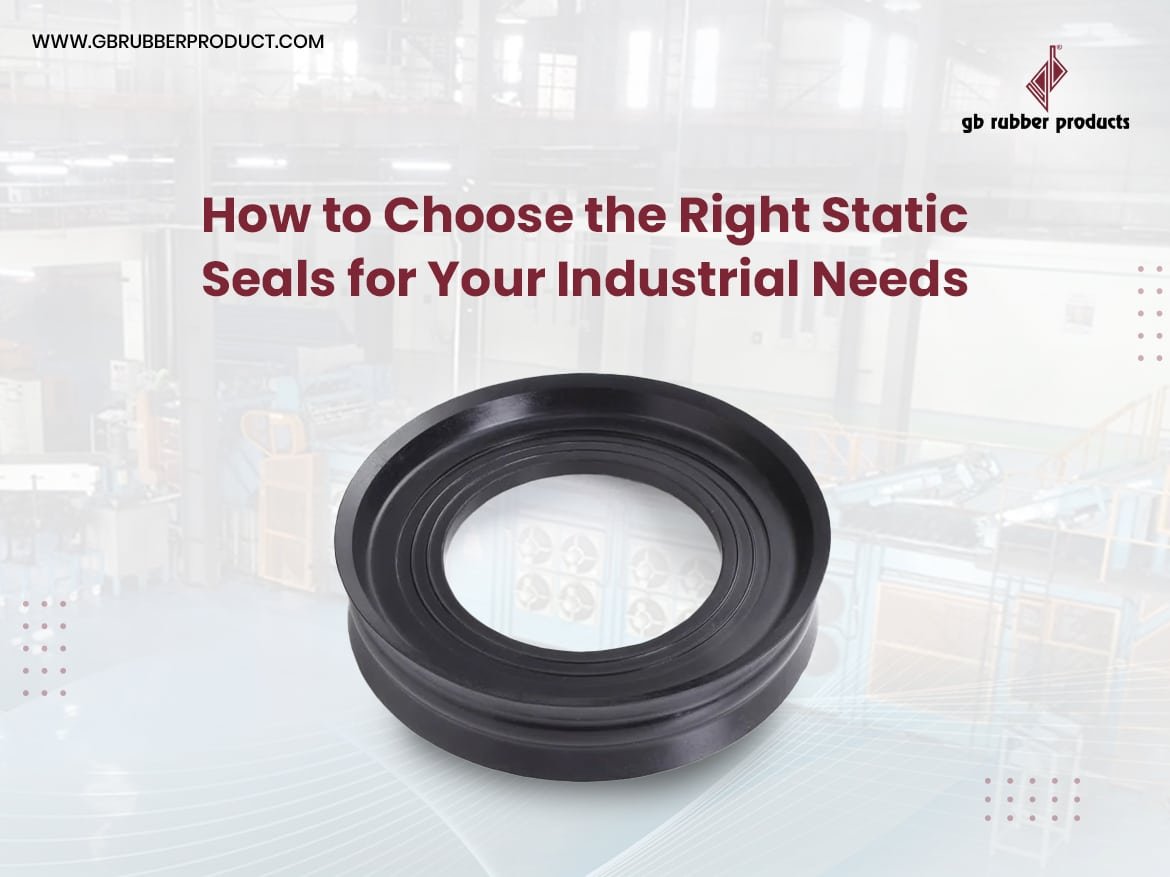
What Are Static Seals?
A static seal is a mechanical seal that is installed between two non-moving surfaces in order to keep liquids, gases, or contaminants from leaking. Since the surfaces are stationary, static seals usually undergo less wear and have a longer lifespan compared to dynamic seals.
Typical examples include O-rings pressed between flanges, gaskets between valve housings, and pressure vessel face seals. For Indian industries, static seals find widespread applications in pipelines, auto systems, and heavy machinery, where longivity and adherence to national norms are critical.
Static Seals vs. Dynamic Seals
Though both static and dynamic seals play the same role—preventing leaks—their uses are different:
Static Seals:
- Applied where two surfaces are static.
- Examples: flange gaskets, valve O-rings.
- Benefits: longer life, reduced wear, and low maintenance.
Dynamic Seals:
- Employed where surfaces slide against one another (rotating shafts, pistons).
- Examples: shaft seals, hydraulic seals.
- Need sophisticated designs to accommodate friction and wear.
- In applications where reliability and extended service life are paramount, static seals tend to be the first choice.
Typical Types of Static Seals
Static seal type is determined by pressure, temperature, and medium sealed. These are the most common:
O-Rings
- The most universal static sealing solution.
- Applied to flanges, pumps, and hydraulic systems.
- Found in materials such as nitrile rubber, silicone, and EPDM.
O ring producers
such as GB Rubber Product offer approved, high-performance versions.
Rubber Gaskets
- Flat seals inserted between two hard surfaces.
- Found in pipelines, pressure vessels, and water treatment plants.
- In materials ranging from natural rubber, neoprene, to nitrile.
Profile Seals
- Seals shaped to fit specific industrial machinery.
- Beneficial in industries demanding non-standard sealing solutions.
Bonded Seals (Dowty Seals)
- Vulcanized rubber sealing elements bonded onto metal washers.
- Offer consistent sealing in hydraulic and high-pressure applications.
- Applications of Static Seals in Indian Industries
Static seals are applied wherever leakage prevention is of prime importance. Some of the key applications are:
Oil & Gas Pipelines – Leak prevention in flanges and joints under high pressure.
Automotive – Sealing in engines, gearboxes, and fuel systems.
Water Treatment Plants – Leak-free sealing in pipes, pumps, and storage tanks.
Power Plants – Ensures boiler, turbine, and pressure vessel safety.
Construction and Plumbing – Sealing plumbing system and building joints.
These applications identify why utilizing high-quality rubber seal manufacturers in India is crucial.
Advantages of Using Certified Static Seals
When companies utilize certified and high-quality static seals, they have several advantages:
Leak Prevention: Ensures safety by preventing dangerous leaks of gas, oil, or chemicals.
Durability: Static seals last longer in fixed applications, reducing replacement costs.
Cost Savings: Minimized downtime and fewer equipment failures.
Compliance: Meets Indian ISI/BIS standards required for safety audits and certifications.
Versatility: Available in multiple rubber materials to suit different industrial environments.
Common Mistakes to Avoid When Selecting Static Seals
- Despite their simple design, many gasket and seal failures happen due to poor selection or installation. Mistakes to avoid include:
- Applying non-certified seals to high-pressure or safety-critical conditions.
- Overlooking chemical compatibility—e.g., natural rubber in oil systems degrades rapidly.
- Incompatible sizing—selecting seals that are not the right fit causes leaks.
- Purchasing low-cost imported products often leads to failures and poor performance in demanding Indian industrial environments.
- To avoid such problems, industries can depend upon reliable suppliers such as GB Rubber Product, an established rubber products manufacturer in India, renowned for precision-engineered seals.
Conclusion
Static seals are a fundamental component of Indian industries today, providing safety, compliance, and cost-effectiveness. From bonded seals to O-rings, every seal is used for a specific purpose in vital applications like pipelines, automotive, and power plants.
By opting for certified products from authentic rubber seal manufacturers in India,companies can ensure durable performance and safety compliance.
GB Rubber Product, one of the top O ring manufacturers and rubber products manufacrtuers in India, provides an extensive array of static sealing solutions that are tailored to the needs of Indian industries.

